
He understands everything. So why isn't he talking?
When your toddler understands everything but isn't talking yet, and what to try first.
· Updated
A note from Nicole
Happy Tuesday.
If you have a quiet toddler, you might know this one. He follows every direction, points to exactly what he wants and brings you the right book every time. He clearly understands everything. He just isn't saying much yet, and the more you notice it, the more you want to ask him to say it.
This week's guest expert is Ashley Lotringer, M.S., CCC-SLP, a speech-language pathologist and the founder of Lots of Speech Pediatric Therapy. She wanted to talk about the gap between understanding and talking, and what helps more than quizzing.
This week's story
Caleb is two, and he understands just about everything you say to him. He just doesn't say much back.
Tell him it's time to go outside and he's already looking at the door. Ask where the dog is and he points at Biscuit before you finish the sentence. He brings you the exact book he wants, and he knows where his shoes go.
His mom, Hannah, has gotten very good at reading him. A point at the fridge means milk. A grunt at the high chair means up. Most days she hands things over before he's done pointing.
 Featured specialistAshley LotringerM.S., CCC-SLP · Founder and CEO of Lots of Speech Pediatric Therapy
Keep reading. It’s free.
On Saturday at the park, a little girl about his age went down the slide announcing every step. "I'm going up. I'm sitting. I'm going DOWN." Hannah laughed with the other parents and felt her chest tighten a little.
On the walk home she picked a ball up off the grass and held it out. "What's this, Caleb? Say ball. Can you say ball?" Caleb looked at the ball, then at her, then away. By the third ask he was staring very hard at a parked car.
That night she told her sister on the phone, "He understands everything. I know he does. So why won't he just say it?"
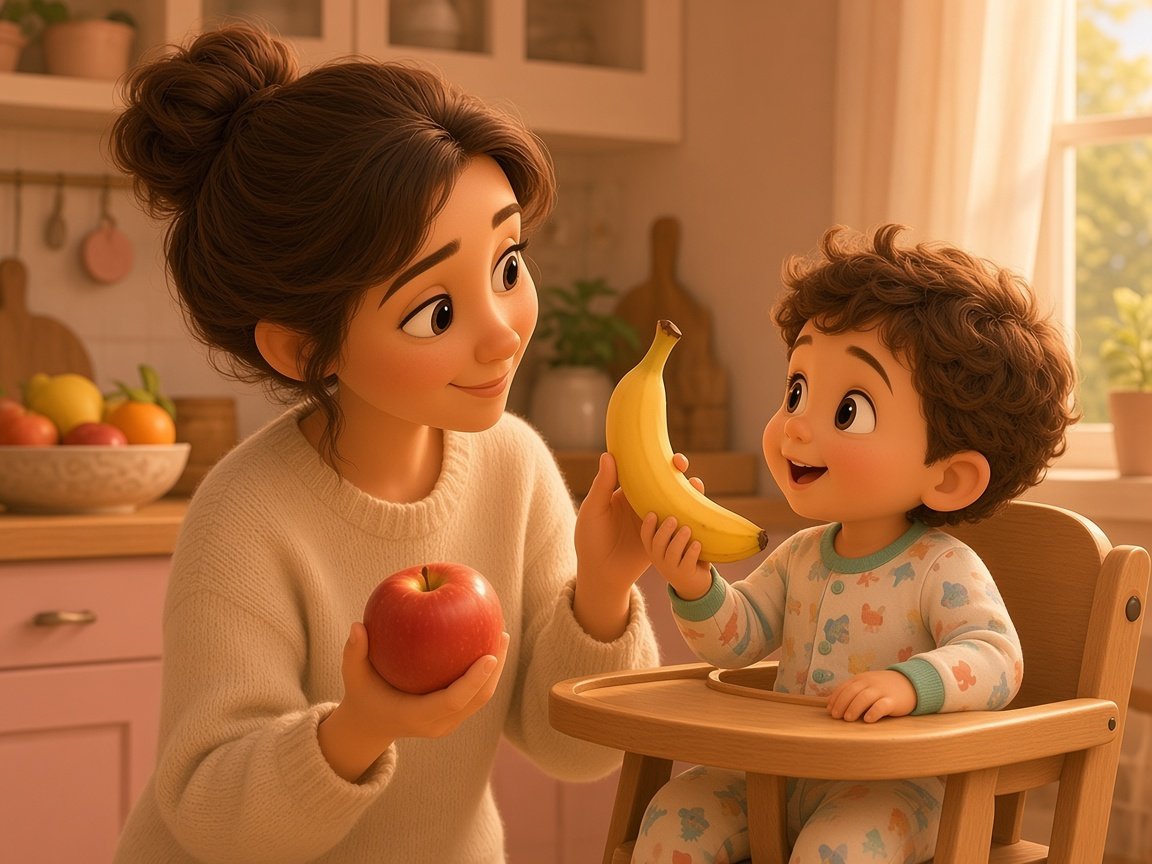
The next morning Caleb pointed at the fruit bowl, and Hannah reached for the banana the way she always did. Then she stopped. She held up the banana in one hand and an apple in the other. "Banana or apple?" she said, and then she didn't say anything else.
It felt like a long time. Caleb looked at the banana. He looked at the apple. He looked at her like she'd forgotten how breakfast worked.
Then he patted the tray and said, "Nana."
"Banana," Hannah said. "You want the banana." She peeled it, handed it over and did not ask him to say it again.
That afternoon he was pushing his trucks around the kitchen floor when one rolled off the edge of the rug. "Uh-oh," he said, very quietly.
Hannah was pretty sure she'd never heard that one before. She said "Uh-oh!" right back, and he rolled the truck off the rug eleven more times to hear it again.
Talk soon, Nicole
The practitioner's take
Founder and CEO of Lots of Speech Pediatric Therapy
Understanding and talking are two different skills. Understanding almost always comes first.
A child can have strong receptive language and still need time and support to build expressive language. That gap is common. It does not mean he is not listening, or that he is not learning. It often means his understanding is ahead of his talking, which is exactly how language usually develops.
Pointing, waving, reaching, and shaking his head are all communication. They are not a replacement for words, but they are a foundation for them. If your child is doing these things, his understanding is working.
If adults are very good at guessing what a child wants, the child does not always need words to get his needs met. He points, you hand it over, and the moment passes.
When parents worry, the instinct is often to test. "What's this? Say car. Say it again. Can you say ball?" It comes from a good place. But quizzing can actually make talking harder. Children learn language best in low pressure moments, when they are playing, exploring, and enjoying the interaction. That is where talking grows.
What matters is not comparing your child to the loudest talker at the playground. What matters is watching his own pattern, and whether his talking is growing over time. Trust your instinct. If you are worried, it is worth checking. Early support is not overreacting. Consider reaching out if your child understands a lot but says very little, if his talking does not seem to be growing over a few months, if he has lost words he used to say, or if you feel unsure and want guidance on what to try next.
Did a word show up when you stopped asking? Join the discussion →
One little idea
Founder and CEO of Lots of Speech Pediatric Therapy
Model the word, then wait.
Instead of asking "What's this?" try saying it for him. "It's a car!" Then wait. Give him five quiet seconds. Do not repeat the question, and do not fill the silence. That pause matters. It gives him time to process what you said, to plan his own response, and to try a word, a sound, or a gesture. The pause is where talking starts. If he uses one word, you can model two. "Car." "Blue car."
Recommendations
Founder and CEO of Lots of Speech Pediatric Therapy
- 💬 Book a free consultation with an SLP at lotsofspeech.com. Lots of Speech Pediatric Therapy offers play-based speech, language, and feeding therapy for ages 1 to 15, in schools and homes in Broward County, Florida, plus teletherapy across every city in Florida.
- 📱 Follow @lotsofspeechtherapy on Instagram for daily, play-based language tips for kids.
- 📖 Read the full piece, “He Understands Everything. So Why Isn’t He Talking?” at lotsofspeech.com.
- 🎧 Yoto: 45% off select Yoto Mini bundles in their Black Friday flash sale, through Nov 29. See the deals.
- 🎶 Tonies: 25% off sitewide during the Tonies Black Friday Sale, taken off at checkout. See the sale.
- 🧸 Melissa & Doug: 30% off with code BFCM2026 at checkout, Nov 23 to 29 (some exclusions). Shop the sale.
Mom-topia

What does your Mom-topia look like?
More from Ashley Lotringer